Total Pageviews

Showing posts with label mining. Show all posts

Friday, January 7, 2011

Mining Sand & Gravel

According to the USGS sand & gravel is one of the most accessible natural resources in the United States second only to crushed stone in value.  It has had an explosive growth rate since the beginning of the 20th century when relatively little was used.  Sand and gravel is mainly used in the construction industry in the form of construction sand & gravel mainly used in the production of concrete and in bituminous concrete (blacktop).

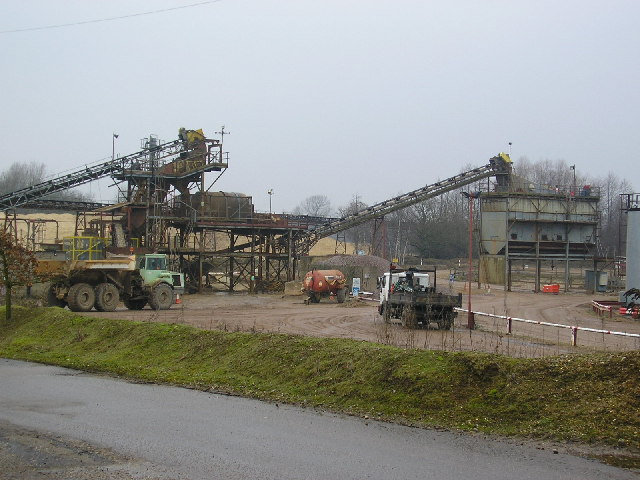
A sand & gravel mine

Annual production of sand & gravel in the United States today it ranks as second in tonnage in the non-fuel minerals after crushed stone.  It is the only mineral commodity that is produced in all fifty states.  In general the United States is self sufficient in the amount of sand & gravel that is produced annually by producing enough to meet all its domestic needs, and is a small net exporter mainly to places where sand & gravel is used to a certain extent in the areas along the borders with Canada and Mexico.
Demand for sand & gravel is mainly controlled by the level of construction activity that controls its demand.  In the United States the production of sand and gravel has grown significantly since the end of WW II with production in 1950 at 320 metric tons increasing to  approximately 900 million metric tons by 2000.  The level of production has dropped since that time.
Mining sand & gravel is mainly a clean operation in comparison to your local corner bakery although to many people it is unsightly.  This has led to a great misunderstanding on the part of the general public where the perception is that sand & gravel mining is harmful to the environment.  This has caused many sand & gravel deposits to be withdrawn from mining for demographic reasons that in many areas has caused shortages of sand & gravel to occur.
Sand & gravel is a product having a high in-place value that considering the present business conditions costs approximately 50 cents per ton mile.  The further it is necessary to transport the material the more it costs.  Sand & gravel that costs less then $2.00 to produce per ton is apt to cost more then $20.00 per ton delivered. 

This is a reclaimed sand & gravel mine note the conveyor belt in the background with piles od sand.

A great deal of the problem that was the cause of a special investigation by the governors of the Northeast States was brought about by the mistaken perception that sand & gravel mining was environmentally hazardous; it isn’t.  This misplaced perception has done nothing more then increase the cost of virtually all construction projects throughout the United States.

Saturday, December 11, 2010

The Aggregate Industry in America

An example of what aggregates look like
As far as mining goes the value of the Aggregate Industry can far exceed the total value of all other mining operations. If it is reported there are over 7,000 active mines in the entire world there are more than 10,000 pits and quarries in the United States alone producing a wide variety of products ranging from simple sand and gravel, to crushed stone and a whole plethora of other industrial minerals. This type of mining is nowhere near as glamorous as mining for gold, but in reality a good producing sand and gravel pit near a viable market is more profitable than a gold mine.

Although it is not realized by many people the aggregate industry forms the foundation of our modern way of life. There is a hardly Day that goes by when somehow or other aggregates don't touch our lives. We find them in our schools, hospitals, factories, roads, bridges, airports and the foundations of our houses. The one thing you can be certain about aggregates is we drive, sit upon, stand on or walk on and drive on aggregates, but that is only part of the fascinating and important story behind aggregates.

This is a story so simple and yet so complex that you really don't know where to begin, but a good place is with economics. This is a story that begins with getting goods to market because our infrastructure depends on the use of aggregates that make up more than 90% of all the asphalt used to build roads or 80% of the concrete used for the same purpose. Lacking a sound infrastructure such as highways, mass transit, airports, water and sewer systems or the rail roads we would neither have an economy, nor could it grow.

Although most people don't realize it every man woman and child in the United States uses about 8.5 tons of aggregate per year. This is a tremendous number when you consider the population of the United States is over 350 million people causing the aggregate industry to measure their production in billions of tons per year, year after year.
An aerial view of a crushed stone quarry

There are two main components to the aggregate industry that are sand and gravel or crushed stone production. Within reason these two parts of the industry are interchangeable strictly depending upon the nearness to market which they are. Aggregates are one his terms in the industry as having a high in place value. The farther from the quarry you have to move aggregates the more expensive they become because of freight charges.
A producing sand and gravel operation

Although there are some large operators in the aggregate industry most of the production really depends on small family operated facilities. It has been estimated that there are over 10,000 active quarries in the United States alone with a preponderance of them producing crushed stone. There is minor aggregate production that has developed using iron slag as its base material, but this has a limited market.

Tuesday, November 30, 2010

How to Find a Job in Mining

One of the hats I wear is as an expert on the Internet a job that makes me an ordinary guy with a briefcase and a new pair of shoes fifty miles from home.  My expertise is supposed to be in geology, but the way it has worked though is most of the questions are how to get a job in the mining or oil and gas industries.  A job for which we are not the highly qualified expert, but we try.


How to Get a Job in the Mining Industry:

If you can't read German this is some miners at work in the 15th century by Georgius Agricola the father of mining engineering in his book De Re Metallica. This woodcut illustrates some early mining equipment that was in use then.    
The first thing you have to realize is that the mining industry is a lot of hard work, and not only that it is a boom & bust industry that operates on the whim of the overall economy of industry as a whole.  Mining is only one of the first steps on a long road until a finished product makes it to the final customer.

For the sake of this argument we will consider that you have a college education although some of the steps in this article apply to everyone.

·        Have an applicable specialty – basket weaving does not apply.
·        Get good grades – partying does not apply.
·        Most colleges have a placement agency that acts usually as a lifetime employment agency for their graduates, use it!
·        Most colleges also have career counselors that are often in your department, use them!
·        Prepare a good resume or CV before you go job hunting.
·        On the back pages of all trade journals there are usually help wanted ads, use them!
·        Most big mining companies have training programs, use them!
·        Most mining companies have web pages, read them if you are interested!
·        Most mining companies on their web pages have a listing you can click on saying, “Careers” or something like that, read them!
·        Practice the interview with a friend before you show-up for the real thing!
It takes a certain amount of patience to be a miner, and by the way if you have any questions you would like answered just leave them in the comments box at the bottom of this blog.

Mark Twain once defined a mine as a deep hole in the ground with a damned fool at the bottom, and a damned liar at the top – Maybe he got it right!


Sunday, October 31, 2010

The Difference between Mining, Quarrying & Prospecting

Mining, Quarrying & Prospecting are one of man’s oldest endeavors from the time he picked up the first rock from the surface of the earth.  That simple action, a form of surface mining started the whole practice of mining that has come down thru time to the present.  Mining over the years since the first man picked up that first rock has divided into a many faceted industry.  What used to be as simple as bending over and picking up a pebble has burgeoned into the monstrous endeavor of today with their great mining machines.  Some of these machines are so big they will boggle your mind.  Today’s mining industry has come along way since its simple beginnings.  Now we have the vast pits from surface mining, other mines are deep underground sometimes miles into the earth.  Most of these mines are developed to produce minerals of value either metal ores or industrial minerals.

Quarrying no doubt is the senior practice of extracting materials from the earth unlike a mine the quarry operator is more intent on extracting earth materials whether they be stone, sand & gravel, or clay.  These earth materials require little or no work to prepare them for the market and their ultimate use.  Many of these materials are used in the construction industry where they are often termed building materials.  As a rule they are sold as-is straight from the quarry in what is called crushed stone where the rock is crushed into small fragments or as dimension stone where the stone stays as it is from the quarry although some of this stone is “dressed” for its final use.  Some quarries are called cement quarries where the product is crushed then put through a rotary kiln to produce Portland cement.  Producing sand & gravel production is another form quarrying where the earth materials are already reduced to fragments by natural action requiring nothing more then to be screened and washed, loaded and put on a truck.  Clay is another product of quarrying where the clay is used for brick making or ceramics.

Neither of these operations would exist if it were not for the prospector.  He is often pictured by the public as a bearded old cuss leading a donkey through the desert with a load of tools and supplies on the donkey with a gold pan in his other hand looking for the next strike.  This picture of a prospector is a far cry from this popular picture.  The prospector is someone that goes out into often unexplored territory searching for gold or some other mineral.  In the past he used his eyes examining every outcrop or tested the gravel deposits carefully in every stream looking for paydirt.  Today’s prospector often goes by the name of “exploration geologist with a whole plethora of electronic instruments to aid him in his search, but the two most valuable tools are his eyes, a pick and shovel and a gold pan.