Total Pageviews

Showing posts with label Mines. Show all posts

Monday, October 24, 2011

Introduction to Mining

This piece of art is composed of earth materials.


There are about 7,000 active mines on the face of the earth as we speak for a wide variety of minerals and ores that are produced to support our way of life and indeed our civilization.  The products from these various minerals range from arsenic to zirconium with the minerals in demand at a particular moment in time causing a situation that might just as well be called, “The Mineral of the Month Club.”  Another way to put it is what mineral is in style?

It seems that at this moment the supply of rare earth minerals (REM) are scarce. The hunt is on worldwide for these minerals that at present are mainly found in the clay deposits of China.  The Chinese, the world's largest producer of REM have restricted the export of these elements from China causing a worldwide search for REM minerals or replacements for them. This has become finding these minerals a high priority for prospectors worldwide.

This Rolls Royce Phantom was also made from earth materials.
Photo by Brett Weinstien 


From these mines are produced many of the things that we take for granted. In two of the products produced from mines that account for some of the highest tonnages are sand and gravel, and crushed stone. For the most part these commodities are invisible to the average person although our civilization is built upon them. There is hardly a facet of our civilization that is not touched in one way or another by mining. It is man's use of these materials upon which our civilization is built. If there were not further products of various minds we would probably still be living in trees. The oldest mine in the world is located in Eastern Africa is the Lion Mine that produced iron ore that was used by early man for decorating his body about 70,000 years ago.

Mines are the source of all the metals you see in buildings, cars, airplanes and all household products you see around you. They also produced many of the raw materials that were used in construction. Other minerals are used in the chemical industry. The energy industry is also a large user of other minerals like coal or oil or uranium. Uranium itself accounts for a good share of electricity that is used in the world. Some of the largest deposits of uranium bearing minerals are found in northern Saskatchewan.

Although you probably do not see the connection between the paper industry and mining it exists because some of the minerals like limestone when it is crushed into a fine powder is used as a sizing in the manufacture of paper. A good share of this powdered limestone is produced in northwestern Connecticut by Minteq. More powdered limestone as calcium carbonate is mined by Minteq in North Adams, Massachusetts this USP certified for use in medicine. Just think the next time you take an antacid it was dug her from the ground in Massachusetts.

Gold is another metal produced from mines it is not only beautiful when used in the manufacture of jewelry it also has a high monetary value, and is used in many industrial applications such as electronics and even in the aerospace industry.

Mining is decrying being many because of their minds minors are displayed on the earth. The truth is mankind has gotten to be where it is because of its ability to make use of earth materials. Those who think otherwise are either ignorant or foolish, but this feeling is nothing new that occupies most of the first chapter in De re Metallica the first book on Mining engineering written in the early 1500s by Georgius are you Agricola. The first chapter of this book is devoted to exactly the same subject, and Agricola was writing about the same kind of people.

Tuesday, December 28, 2010

The uses of Pumps in Mines

A pump is a mechanical device used for transferring fluid from one point to another. There are several different varieties of pumps that are found in the marketplace, but the most common in use are the centrifugal pump and the piston pump. The most common pump in use now is the centrifugal pump although in the past the more common variety of pump was operated with Pistons. The primary use for pumps in the mining industry is for the removal of groundwater that seeps into the mine from the surrounding strata.

This is a Cornish piston pump used in the 19th century to pump water from a mine.

In some mines the order is reduced to a powder that is mixed with a fluid allowing it to be pumped as a slurry. Other pumps are used to supply power too hydraulic units that are attached to various types of mining equipment.

No matter what its use; pumps require an external power supply that used to be supplied by steam, but is now replaced by diesel. In many cases the motive power for operating a pump is supplied by electricity this is especially true of the smaller pumps that have electric motor attached correctly to the shaft of the pump.

A cutaway view of a centrifugal pump.


Pumps are also used in various hydrometallurgical processes used to separate ore from gangue. This is illustrated by their use in flotation cells for separating sulfide minerals from the surrounding rock. In other cases pumps are used in the heap leach method of recovering gold with a solution of cyanide. In this case the pumps pressurize a cyanide solution forcing it out through nozzles where is allowed to seep down through the heap of crushed ore where it is collected in a sump at the bottom of the heap to be recirculated through the heap several times until the solution becomes pregnant with gold.

The pregnant solution is then drawn off, and the gold or other metal values are removed by reacting to solution with a powdered metal such as zinc to precipitate the gold that is then taken to a refinery for further processing.

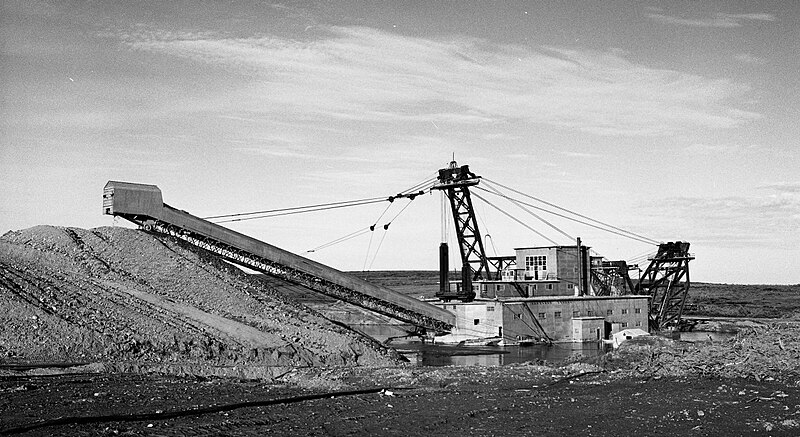
In alluvial or placer mining centrifugal pumps are also used in several places notably in supplying water to sluice boxes or hide bankers. They are also used in the operation of a suction dredge for the removal of mineral laden sand and gravel from the bed of the stream. In larger gold dredges they are actually used to process the gold bearing sand and gravel.

A gold dredge in operation in Nome, Alaska.

 As you can see there are many uses for pumps in the mining industry, and because man is an ingenious creature he keeps developing more!

Monday, December 13, 2010

Closed Mines -- Lost Jobs


The basic problem is for the past half century the country has been hell bent on ruining the economy, and unfortunately they have almost succeeded.  Some serious rethinking about priorities is badly needed.  One of the biggest problems is frankly the EPA they have virtually made it impossible to accomplish anything in the United States.  

We need factories in this country, but the environmental movement has made building one too costly and virtually impossible.  Reforming the EPA so as too streamline the permitting process both cost and time wise would go a long way to begin getting our house in order.

As an example there are any number of gold mines in the Colorado Gold Belt possessing $50 million worth of proven assets, but with the permitting process to reopen these mines costing $75 million the mines remain closed.  Closed mines translate into lost jobs.